Showing posts with label funny. Show all posts

Tuesday, July 9, 2013

She's a Party Girl, But Not the Way You're Thinking

How do you recreate the magic that inspired you in the first place?Sarah Mason sure doesn't have the answer to that one. She is one of those “good first novel, mediocre sequels” authors for me. She wrote a brilliant first novel, and the sequel was still pretty good (just couldn’t measure up to the first), but by the third, the magic has been drained. And from what I hear, her fourth isn't so hot, either. 

As I’ve said before in my review of Sarah Mason’s other book, Society Girls, Playing James is a great British chick lit book I would definitely recommend to people. The characters were varied, funny, loveable and pretty well developed (it is chick lit after all; I’m not exactly expecting Pulitzer Prize-winning material here). The plot moved along quickly with plenty of hilarious snafus and the ending left me satisfied. In the sequel, the Colshannon sisters were up to their usual adventures, but it just didn’t have the same oomph.

Party Girl does not pick up where Society Girls left off, nor does it have any of the same characters. Instead, it follows Isabel (I kid you not, I had to look up her name. That’s how memorable she is), a party planner in London who is requested to plan an event for a family she spent her childhood with. The estate she spent her summers on now holds bitter memories, all because Simon Monkwell flipped from best friend to bitter enemy in a matter of weeks.

The problem with this novel does not lie with the hijinks or the plot. It lies with the main characters themselves, who are just trite. It’s pretty bad when the only word you can come up with to describe your protagonists is “trite.” Simon is now this businessman with a ruthless reputation, which in the grand tradition of chick lit is revealed to be a façade. I apologize to those of you yelling “spoiler alert” at your computer screens, but if you can’t see it coming, I think you need to read more. He has a hybrid between an icy attitude and cool politeness aimed toward Isabel, yet she’s supposed to be in “like” with him. They’re also supposed to have chemistry, especially once Isabel understands why he acted the way he did, but I just didn’t feel it. The chemistry between them is just not palpable.
 
"Oh, uh, I failed chemistry...."
The lack of chemistry could be attributed to the boring Isabel and Simon. I hate to compare Party Girl to Playing James, but I just can’t help myself. While James Sabine was cynical and uptight, he was the perfect antithesis to Holly Colshannon’s chaotic whirlwind of a life. His wry and dry comments made everything that much funnier (think House, Chandler or Frasier in terms of witty quips). Simon is just boring and Isabel isn’t much more memorable. I take it as a bad omen that I had to look up her name because I couldn’t remember it for the life of me.

It’s left to the crazy relatives to carry the weight and offset Simon and Isabel’s “relationship” by making irrational decisions, creating comedic mishaps and shaking up everything with their eccentric personalities. At one point, there is a tarantula loose in the house, which causes panic and mayhem among the residents. There was a great opportunity for a tension-filled romantic scene between Simon and Isabel, but because they’re boring, nothing happens. Go figure. If it weren’t for the stereotypical, yet still enjoyable, crazy family members and coworkers, this book would have fallen on its face faster than a drunk giraffe on roller skates.

It is important to remember that this is a fluff novel. It doesn’t need the substance other novels need, as long as it makes the reader happy and leaves them feeling warm and squishy inside. Party Girl did not leave me feeling happy, just bored.

This brings me to an interesting question: how do you qualify boring? Boring is subjective. What you might qualify as boring (baseball, fishing, most nonfiction, vanilla ice cream) others might qualify as some of their favorite things. In the end, it comes down to what you think is boring. If you can’t handle the craziness of the Colshannon family or don’t like eccentric characters, you might like this novel more than Sarah Mason’s other novels. However, if you can’t stand a single moment of normalcy, I would recommend Sophie Kinsella or Jill Mansell. You can still pick up this book, but be warned that not even the cringe-worthy scenes can make up for the love story that is lacking. 

Wednesday, June 26, 2013

A Solitaire Addiction Was in My Cards

I… I have a confession to make. One of a very serious nature. It’s not easy to talk about, but if the internet isn’t a safe place to talk about serious and personal matters, then what is? A therapist? Please.

I have an addiction. They say admittance is the first step, so I guess you could say I’ve taken the first step. I am admitting I have a problem. I should get help, but I don’t think I’m at that point in my life that I can get it quite yet.

Just looking at it gives me an itch...

I am addicted to solitaire. I know about the problems that arise from card addictions. Solitaire is, after all, the gateway to other game addictions. I can’t help it. If I open a video, I drag it to one side and play solitaire on the other. It started out with plain solitaire, but then it evolved to spider solitaire, despite my intense phobia and severe aversion to spiders. That doesn’t stop it. It doesn’t affect my addiction in any way. If anything, it just proves my addiction to solitaire is stronger than my phobia of spiders.

I imagine my addiction will only progress farther if I don’t try to stop it now. One day it’s solitaire, then it’s spider solitaire, and before you know it, I’m playing a full blown game of Monopoly. And it doesn’t just have to be digital. I have the Monopoly app on my iPod, where I can play against the computer, but what if my iPod dies and I can’t charge it somehow? I will have to resort to playing a full board game of Monopoly against myself! I will be the banker and 2-4 players. I will buy myself out, I will bankrupt myself and I will win and lose. And not only that, but we have several editions of Monopoly! I could play 4 straight games of Monopoly and they will all be different!

The worst part of the situation above is that I don’t even like Monopoly. Seriously. We play it every Thanksgiving as a family and I am one of the first people to go bankrupt because somehow I can’t figure out the balance between liquid capital and assets. I have come to loathe Monopoly. It’s sad to admit that 75% of that reason is simply because I’m not good at it, but I also simply don’t enjoy it.


"Look how much we don't want to kill each other! I'll get you back for taking
St. James Place,  Bobby. You best sleep with one eye open tonight."

Give me Pictionary or Cranium- now there’s a game that I enjoy. Also Clue.

But Clue will probably be on the list of games I will be addicted to. I will start carrying around this giant bag and it’ll be chock full of portable or travel versions of board games and a deck of cards to play solitaire with when my laptop/iPod is dead. Maybe it’ll get so bad that I will actually learn how to play Hearts, Free Cell or, God forbid, Bridge.

Rock bottom will be all those games that are so mind-numbingly boring or so easy that as soon as you’ve set the game up you’ve already regretted your decision. You know which games I’m talking about. I’m talking about Go Fish, Chutes and Ladders, Risk (I am NOT a strategist, nor am I patient when it comes to this game), Candy Land, Battleship, and at the very worst, the card game of War. That’s right. A card game where there is no strategy involved, not even the hand eye coordination of slapping cards to acquire them like in Egyptian Rat Race. You just lay down cards and keep laying down more when you and your “opponent” have laid down the same card. And it’s such a long game- it just keeps going and going and going and going and going….


Good God, there's even a card game app. This is a new low. 

It does feel better to get this off my chest, I must admit. I’m still on the gateway game, but I have no idea when solitaire won’t be enough for me. Some of my friends started and run the Tabletop Gaming club at my university, and I went to some meetings thinking it was a support group. How wrong I was. It was an enabling club was what it was. What it is. There they were, a deck of cards, just begging me to play a physical game of solitaire. How bad could it be? Bad. Very bad. I perpetuated my addiction of solitaire and I was introduced to a slew of new board games to become addicted to.

God, grant me the serenity to accept the things I cannot change, like opening up a game of solitaire every time a YouTube video starts, change the things I can and when a card game is acceptable, and the ability to know the difference between enjoyment and obsession…

Friday, May 3, 2013

The Restaurant at the End of the Universe: Don't Panic. Continue Not Panicking.


“The Story so far:
In the beginning the Universe was created.
This has made a lot of people very angry and been widely regarded as a bad move.”

-The Restaurant at the End of the Universe, Douglas Adams

Could there be a more perfect beginning to this book? No, there is not. The opening to the book, perfectly combining humor, satire, history and science (I’m being facetious here) sets the bar pretty high for Douglas Adams’ sequel to the brilliant Hitchhiker’s Guide to the Galaxy. Luckily, he set the bar himself and knows how to vault over it like the literary genius/comedian that he is.

I do not think I can summarize the plot of this book, if the difficulty of wrapping the first book up into a neat little abstract has anything to say about it. The best I can do is give you a short play-by-play of the highlights of the book, so about every other paragraph (and that’s just an average). I think just the best of the best will suffice.

The introduction of Ursa Minor Beta, or “one of the most appalling places in the known Universe,” is just genius. It “is excruciatingly rich, horrifyingly sunny…[and] it can hardly be insignificant that when a recent edition of Playbeing magazine headlined an article with the words ‘When you are tired of Ursa Minor Beta you are tired of life,’ the suicide rates there quadrupled overnight.
Not that there are any nights on Ursa Minor Beta.”

The Restaurant at the End of the Universe (also known as Milliways), is a pretty hilarious concept, too, but only because your preconceived notions of the context of the word “end” here are shattered. When he writes “end” in the same phrase as “universe,” we all think of physical end, as in location, but Douglas Adams means “end” as in “destruction.” The restaurant is protected by a time bubble that resets itself every meal period so the diners can witness the end of the Universe. As it is a “time location” and not a “location location.” This way, you can come back multiple times.

As usual, Douglas Adams likes to shoot all your ideas about time travel and relativity to hell. Also, he introduces an amazing new tense that tells you how “to describe something that was about to happen to you in the past before you avoided it by time-jumping forward two days in order to avoid it.” Of course, that means that you must describe the event differently depending on if you’re talking about it in the future, the past, natural time, etc. It is known as the Future Semiconditionally Modified Subinverted Plagal Past SubjunctiveIntentional. This is to replace the “Future Perfect.” I cannot even describe this tense. It is practically a new language even J. R. R. Tolkien might be a little proud of.

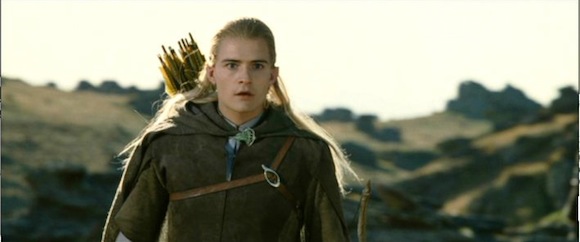
"Legolas! What wioll haven do your elf eyes willan seen?"
"They're willing taken the hobbits to Isengard!"
The existence of a spaceship so black you cannot make out its shape or even tell how close you are to it, let alone distinguish any of the controls in the ship. Because it’s black on the inside, too.

Then there's the almost-paradox of writing the guidebook: “The simplistic style in which [the statistics of The Hitchhiker’s Guide to the Galaxy] are written is partly explained by the fact that the editors, having to meet a publishing deadline, copied the information off the back of a packet of breakfast cereal, hastily embroidering it with a few footnotes in order to avoid prosecution under the incomprehensibly tortuous Galactic Copyright laws. It is interesting to note that a later and wilier editor sent the book backward in time through a temporal warp, and then successfully sued the breakfast cereal company for infringement of the same laws.” Amazing. Simply amazing.

I hesitate to disclose my favorite part of the novel, the end, but truthfully, I don’t think you can really have spoilers in a Douglas Adams book. Each sentence is not so much a an event not to be disclosed to non-readers, but more of another piece of an adventure. A stepping stone, if you will. If each Douglas Adams book were a ladder, each chapter is simply a piece of wood (or metal, depending on the type of ladder you’re imagining) that makes up the ladder. If you remove a splinter or even a rung, the entire ladder will not fall apart, but it does take away from the ladder’s essence.

So when I tell you my favorite part, it does not make the story unreadable. In a way, it’s like the universe itself; the story and the universe are infinite and could continue in any direction indefinitely.

The Restaurant at the End of the Universe
 ambled along, delighting me with every page, but the best (and funniest) part was the ending. Arthur and Ford end up on this spaceship, Ark B, to find millions of bodies in suspended comas. What kinds of people are they? “‘Hairdressers, tired TV producers, telephone sanitizers, insurance salesmen, personnel officers, security guards, public relations executives, management consultants, you name it.’” Why, you ask? And actually, Ford and Arthur essentially ask it themselves. “‘The idea was that into the first ship, the ‘A’ ship, would go all the brilliant leaders, the scientists, the great artists, you know, all the achievers; and then in the third, or ‘C’ ship, would go all the people who did the actual work, who made things and did things; and then into the ‘B’ ship–that’s us–would go everyone else, the middlemen.’” As funny as it is, it just keeps getting better. The planet they came from, Golgafrincham, sent Ark B off to “rid themselves of an entire useless third of their population. The other two-thirds stayed firmly at home and lived full, rich and happy lives until they were all suddenly wiped out by a virulent disease contracted from a dirty telephone.” Oh, the irony.

Of course, the downside to sending a colony of people such as these off to a new planet is that some things hold precedence over others. For instance, hairdressers electing to create curling tongs instead of developing fire. And in creating the wheel, the marketing department must first decide on a color. And instead of exploring the area, their film producers make a documentary on the indigenous cavemen in the area.
  

"I've always been told hairs before bears. As in protecting yourself from bears. You'd be surprised
 how much perfectly styled tresses can ward off danger."
But the most hilarious of all, and most satirical, is that they develop a fiscal policy. Ford wants to know how they can have money when they don’t make money. As a response to saying it doesn't grow on trees, the management consultant says “‘Since we decided a few weeks ago to adopt the leaf as legal tender, we have, of course, all become immensely rich… But we have also run into a small inflation problem on account of the high level of leaf availability, which means that, I gather, the current going rate  has something like three deciduous forests buying one ship’s peanut.’” So, to revalue the leaf, they are going to burn down all the forests. I cannot stress how loudly I laughed at this point.

I think Douglas Adams just sat in his room and decided to make fun of everyone he could think of. And as they say, the pen is mightier than the sword. The worst part is that I can actually see this playing out in similar situation, if to a lesser degree. I am just glad that Adams has commemorated it on paper. And, er, Ebook/tablet screen.

The book ends with Arthur trying to teach the cavemen to play Scrabble with rocks, “‘but they only word they know is grunt and they can’t spell it…. [He’s] probably spelled crzjgrdwldiwdc again, poor bastard. I keep on telling him there’s only one g in crzjgrdwldiwdc.’” Man, on a triple word score, that word would be pure gold.

Sunday, April 7, 2013

Bossypants: A Review


      Upon the shocking revelation that I will be reviewing books (Whoa! Your like totes the first person ever to review books online or in general!!! OMGZ lolololol you shuld b an editor!) Yes, that was poor grammar and spelling ON PURPOSE.
            Here goes nothing!
            Anyone who has any sense of humor or has any respect for American sketch comedy has heard of Tina Fey. If you haven’t, and I highly doubt that, I would suggest holing up in your room, locking the door, popping some popcorn and watching several straight hours of the best of SNL. The nineties edition. And then watching all 7 seasons of 30 Rock, because that show is amazing. She says in her book that they didn’t have many viewers, and that honestly shocked me. I love that show, and I can’t imagine why more people didn’t watch it! Probably off watching The Big Bang Theory. Losers. (Now, it’s not like The Big Bang Theory hasn’t made me laugh, but just because it’s about three scientists and an engineer does NOT make it a smart comedy. Plenty of people have written about this, and I do not have the energy to get into an argument about this. You can read some other people's extensive rants about it here and here.  

            But I digress. The point is that if you love comedy or have a sense of humor, you would love Tina Fey’s book! She’s funny, fresh, funky, fantastic and all other words beginning with “f”! Okay, not all words, but you get my point. The book chronicles important moments (i.e. hilarious things that happened to her and not so much the sentimental ones) from her childhood to current day, but not so much that you have to take a break.
            If you like reading and learning about how it is that she went from awkward child in Pennsylvania to an awkward adult in New York, and along the way worked in sketch comedy and became a writer for SNL. I adore SNL, so I was extremely curious how one goes from just an average person to someone working for a major network, especially on a big hit show like SNL.
            I know a lot of you are thinking that you already don’t have enough time to read, let alone waste your time actually reading nonfiction, but I can assure you, it’s still entertainment, and you get to pick up little funny Fey tidbits along the way!
            Just buy it, alright? Or get it from your local library! Because everyone knows I hate paying for stuff, so I prefer the library.

Next week: I review the third Percy Jackson Heroes of Olympus, Mark of Athena. See ya then!

Friday, December 14, 2012

Jokes


Whoa, guys! I'm actually writing for the second day in a row! I figured, I'm in England right now, so why not write about things? Besides, if this is something I want to do in the future, I should probably practice. Probably.

I am normally a person who makes TERRIBLE jokes or has terrible delivery or timing, but will still laugh at my joke while others roll their eyes or groan or even fake laugh (but it's okay when they're my friends. Or is it? DUN DUN DUN!), but lately, I think I made some good jokes! For instance, last night, a friend from uni and I were watching the stand up comedian Michael McIntyre (or check out this video and try not to laugh) and he made a joke about someone mistaking a BLT to mean bread, lettuce and tomato. In that case, a G&T would be a glass and tonic, right? So we were laughing, and earlier I had asked her if people called others gits, to which she replied that you wouldn't call people of your generation a git, but you might call an older person a git (if you were trying to be rude). "Grumpy old git" is a phrase they might use to describe an old curmudgeonly person like that. So if a G&T is a glass and tonic, a GIT might be a glass, ice and tonic. Could you imagine walking up to a bartender and saying "I'll have a GIT, but it better be old and grumpy!" Okay, maybe it was funnier back then.

Then today my friend was separating the water from her spaghetti, and I asked if she called the device a colander or a strainer. She said she usually called it a strainer, but sometimes referred to it with the former term. I replied, "Strainer things have happened."
"I guess the truth's strainer than fiction."
"Have you seen what I consider the two best movies? Pirates of the Caribbean  On Strainer Tides, and Strainers on a Train."


Haha PUNS.