Wednesday, June 26, 2013

A Solitaire Addiction Was in My Cards

I… I have a confession to make. One of a very serious nature. It’s not easy to talk about, but if the internet isn’t a safe place to talk about serious and personal matters, then what is? A therapist? Please.

I have an addiction. They say admittance is the first step, so I guess you could say I’ve taken the first step. I am admitting I have a problem. I should get help, but I don’t think I’m at that point in my life that I can get it quite yet.

Just looking at it gives me an itch...

I am addicted to solitaire. I know about the problems that arise from card addictions. Solitaire is, after all, the gateway to other game addictions. I can’t help it. If I open a video, I drag it to one side and play solitaire on the other. It started out with plain solitaire, but then it evolved to spider solitaire, despite my intense phobia and severe aversion to spiders. That doesn’t stop it. It doesn’t affect my addiction in any way. If anything, it just proves my addiction to solitaire is stronger than my phobia of spiders.

I imagine my addiction will only progress farther if I don’t try to stop it now. One day it’s solitaire, then it’s spider solitaire, and before you know it, I’m playing a full blown game of Monopoly. And it doesn’t just have to be digital. I have the Monopoly app on my iPod, where I can play against the computer, but what if my iPod dies and I can’t charge it somehow? I will have to resort to playing a full board game of Monopoly against myself! I will be the banker and 2-4 players. I will buy myself out, I will bankrupt myself and I will win and lose. And not only that, but we have several editions of Monopoly! I could play 4 straight games of Monopoly and they will all be different!

The worst part of the situation above is that I don’t even like Monopoly. Seriously. We play it every Thanksgiving as a family and I am one of the first people to go bankrupt because somehow I can’t figure out the balance between liquid capital and assets. I have come to loathe Monopoly. It’s sad to admit that 75% of that reason is simply because I’m not good at it, but I also simply don’t enjoy it.


"Look how much we don't want to kill each other! I'll get you back for taking
St. James Place,  Bobby. You best sleep with one eye open tonight."

Give me Pictionary or Cranium- now there’s a game that I enjoy. Also Clue.

But Clue will probably be on the list of games I will be addicted to. I will start carrying around this giant bag and it’ll be chock full of portable or travel versions of board games and a deck of cards to play solitaire with when my laptop/iPod is dead. Maybe it’ll get so bad that I will actually learn how to play Hearts, Free Cell or, God forbid, Bridge.

Rock bottom will be all those games that are so mind-numbingly boring or so easy that as soon as you’ve set the game up you’ve already regretted your decision. You know which games I’m talking about. I’m talking about Go Fish, Chutes and Ladders, Risk (I am NOT a strategist, nor am I patient when it comes to this game), Candy Land, Battleship, and at the very worst, the card game of War. That’s right. A card game where there is no strategy involved, not even the hand eye coordination of slapping cards to acquire them like in Egyptian Rat Race. You just lay down cards and keep laying down more when you and your “opponent” have laid down the same card. And it’s such a long game- it just keeps going and going and going and going and going….


Good God, there's even a card game app. This is a new low. 

It does feel better to get this off my chest, I must admit. I’m still on the gateway game, but I have no idea when solitaire won’t be enough for me. Some of my friends started and run the Tabletop Gaming club at my university, and I went to some meetings thinking it was a support group. How wrong I was. It was an enabling club was what it was. What it is. There they were, a deck of cards, just begging me to play a physical game of solitaire. How bad could it be? Bad. Very bad. I perpetuated my addiction of solitaire and I was introduced to a slew of new board games to become addicted to.

God, grant me the serenity to accept the things I cannot change, like opening up a game of solitaire every time a YouTube video starts, change the things I can and when a card game is acceptable, and the ability to know the difference between enjoyment and obsession…

Tuesday, June 25, 2013

The Help Have Opinions Too

Apparently I was one of the only people who hadn't read The Help by Kathryn Stockett. I have no idea why I didn’t, but I just never quite had the desire to pick up a book about relationships and people—I prefer my books to contain action, adventure, a fantastical setting if at all possible, humor and all that. I suppose I also view civil rights as a very serious issue and found it hard to believe that someone could make light about the situation.

How wrong I was. Not that the book made light about the situation, but it portrayed the conflicts in the book as a very real problem, but not to the point that it felt like a serious drama. The Help is more of a book about people and relationships, about how different people handle oppression and injustice. It’s almost offensive to simplify it in such a way.

The Help is set in Jackson, Mississippi, 1962, and is told from three points of view: Aibileen and Minny, two maids; and Miss Skeeter, a white girl with a very different opinion about the way black maids are treated. Miss Skeeter gets the idea to write a book about how horrible some of the help’s employers are and the stories the maids can tell. Of course, such a decision never goes off without a hitch; you need to break a few eggs to make an omelet. Maybe some grated cheese, a little salt and pepper, sauteed peppers and onions, a little ham...

Here are the main players:

The Help:
Aibileen: a caring, sweet, loving caretaker of Me Mobley, daughter of Miss Elizabeth Leefolt. She is good friends with Minny. She is not married and has no children.
Minny: Sassy, foot in her mouth, not afraid to speak her mind (gets her in trouble a lot), great cook. Funny! While Aibileen provided much of the sentimental parts, Minny provides a lot of the comedy, but that doesn’t mean either of them are caricatures. Aibileen has her share of laugh out loud lines and some of Minny’s parts elicited “awwww” reactions. 

The White Females:
Miss Elizabeth Leefolt: Not a maternal woman at all, in financial trouble, dislikes people of color, but doesn’t really stick up for herself. While she isn’t outright hateable, she isn’t likeable right off the bat either. She has character depth, though, and her timidity causes her to be more of a background character than she could be.
Miss Hilly Holbrook: a larger, overweight, horrible woman. She is the kind to just commandeer everything and take charge, even if she doesn’t do it right or if no wants her to. She’s bossy, she’s rude and she looks down on the help more than Miss Leefolt. You really get to hate her. She’s the one who starts the Home Help Sanitation Initiative, a movement started to get the help their own bathroom because God forbid someone with darker skin uses her own toilet and spreads “germs only the help have.” Like I said, you really hate her.
Miss Skeeter (Eugenia Phelan): Tall, skinny, frizzy hair, described as not very attractive. Considered a failure by her mother for not being married yet, daughter of a plantation owner. She is very intelligent and a hard worker. She has a degree in journalism and wants to move away from Mississippi and get a life. She is very friendly toward the Help and views them as actual people. She’s the one who starts the book initiative to give them a voice.

Yes, I am sure this is exactly the image Kathryn Stockett had in mind. I am not one of those
people to get upset over small details that- LOOK! HER HAIR ISN'T FRIZZY, OK??!? 

Celia Rae Foote: Newly married to her husband, no friends but is always trying to get into the women’s group Hilly, Miss Skeeter, and Leefolt are in, even though no one is friendly toward her. It’s because she’s built like Marilyn Monroe, wears tight tacky clothing, high heels and lots of makeup- she just doesn’t fit in with all the other women. She needs help acting like a good housewife, but doesn’t want to tell her husband. She is sweet, but clueless. Nice to Minny and treats her like a human being. She doesn’t leave the house!

The way Stockett writes is so true to the characters' personalities. She writes the help with true voice, with no regard to grammar or full sentences. When Aibileen or Minny is speaking, it actually sounds like a black maid in the 60’s and makes for some of the funniest parts in the book. When any of the women’s club members of talking, you believe they are women bred to be housewives in the south.

When it comes down to it all, the book makes you care. From the moment I turned the first page to the moment I closed the book and set it down, I cared. It just made me feel all the things! I laughed, I cried, it moved me Bob. It made me laugh, gasp, tear up, get all squishy inside, happy, sad, angry, yell, etc.

And it’s not just because the characters are good and likable, but the way they are written just elicits a response so subtly and yet necessarily. Miss Leefolt is usually more on the side of Miss Hilly, and yet, she shows moments of vulnerability and fairness that make you still want good things for her. (most likely the opportunity to unconditionally love her children and become a better mother, but not everyone is fit to be a mother.) When I closed the book, I felt like I had been on a journey with these women and been with them every step of the way. I laughed with them, I cried with them and I feared with them.

I read another book review on this man's blog that had a less than favorable review; I wonder if I was just awed by the characters that I overlooked some writing flaws or dimensions of characters. It could be that the book is more suited toward my age group (16-24) than a middle-aged man's age group. Or maybe it's just a question of personal taste. Everyone else I know who has read it fell in love with it like I did. And that blogger's opinion of "an ending that left me feeling unsatisfied" is not something I had a problem with. Given the amount of stirring the characters did in the novel, it made sense that they didn't get their happily-ever-afters. (Though this is not to say that they got the short end of the stick, either.) And if some people don't like the vague ending of the book, I would tell them that life is not a book. There is no ending for us until we die. Until then, there will constantly be new struggles, new joys, new heartbreaks, new people and new adventures. We will never see the "The End" of our lives. 


Oh wait, there's the end. 

Despite other people's reviews, I cannot stress how good this book is. I highly recommend it. I am waiting for Kathryn Stockett’s next book with eager anticipation. If she’s taking her time because she wants it to be good, however, I hope she takes as much time as she needs.

Saturday, June 22, 2013

Dad Is Fat: Observations From a Pale, Balding Man

Hot pockets. Paleness. Laziness. Cinnabons. What do these things have in common? Technically, America would have been an acceptable answer, but the real answer I was looking for was Jim Gaffigan. I suppose he would be a good spokesperson for America. I certainly wouldn’t mind.

Recently he released a book to cover almost all the bases of comedy- TV, movies and books. He just needs a podcast and he’s set! Although that may be a little difficult seeing as how he already does shows and has five kids. As someone who grew up in a house of seven kids, two parents and after I turned 14, a dog, I understand the chaos of living in a big family. Yes, like Gaffigan, I am Catholic. I am the fifth child, so I don’t remember spending much time with younger children. I was one of them at a time! I couldn’t observe them with the mind of an adult.  

Jim Gaffigan’s nonfictional semi-autobiography about parenting is only one of…well… about 20. Maybe less. I know Dave Barry wrote one (or four) funny books about kids and parenting. He is a comedy columnist, after all. Bill Cosby is probably known for one of the best, and he has even worked it into his stand up. It is hilarious. But then again, it’s Bill Cosby. Of course it’s hilarious.

The book itself was easy to read, the chapters were short, and some well-placed pictures added to the humor and sentimentality. It was written with a lot of voice and personality, and if you close your eyes, you can practically see Jim Gaffigan saying it into a microphone in front of thousands of people. Actually, he has even written in some jokes that I recognized from his stand up, but that doesn’t make then any less funny. Jim Gaffigan is also quite self-aware, which makes it nice when he calls himself out on an obvious joke. Take this one: “It’s not just leaving; it’s leaving with stuff. There is just so much stuff to bring when you have young children. When you’re headed to the park, you must pack diapers, wipes, juice boxes, and sunscreen. And then there is the stuff for the kids. (Thank you, I’m here all book.)”
This is what you're supposed to do with books, right?

He knows the joke is easy and a little groan-worthy, yet he couldn’t help himself. Instead of trying to pass it off as something he labored over, he made a joke about his joke. (Jokeception) He knows what he did and he turned a potentially eye-rolling reaction into a wry smile, if not an outright laugh or chuckle. I’ve known a few shows to do that, when a character isn’t really in an episode and instead of trying to work it in, they make a joke out of it. In a brilliant UK series called The IT Crowd, they reference that sort of thing multiple times: once, when actor Richard Ayoade wasn’t in the episode much, they turn his return into a joke. The writers know the audience knows, the audience knows the writers know they know, and so on.

The best part about the book is that even though Gaffigan balances his slightly sarcastic, self-deprecating, dry humor with genuine sincerity and gratefulness for his family. He may make jokes about how hard parenting is and how little sleep he gets (he’s down to three naps a day! Oh the inhumanity!), but he counters with a sentence or two about how amazing his wife is and how much he loves his kids. There is no doubt that he means them with all his heart. To keep from getting too sentimental, he comes back with another joke. It is supposed to be a funny book, after all. A classic example: “I am undeniably lucky to have married a woman like Jeannie. She is energetic, hardworking, and takes incredible care of the kids and me. However, during our marriage there have been periods when she has become rather lazy. Jeannie describes these periods as “pregnancy.” My view has always been, pregnant or not, that does not mean she can’t move some cinder blocks. We are a team, and I have to take a second nap today.

Of course, pregnant women are not lazy. In fact, they are the opposite of lazy. Whatever they are doing, they are also always growing a baby. Even when they are sleeping, they are growing a baby. They are constantly multitasking. I’m often not even tasking.”
Boy, talking about naps sure is-zzzzzzz..... 

Obviously, this book is best suited for people who are parents or have spent a fair amount of time with children between the ages of one and seven, but don’t worry if you’re not in that demographic. The jokes are still funny, but you might not get as much out of them or connect as well. It does help to have knowledge of kids and large family behavior, though. I know one child can be a handful, but bump that number up to five and have the older ones old enough to conspire against you and you’ve got yourself a real disaster zone. If you’re curious, you should inform Jim Gaffigan know that you’re interested in babysitting for him. He’ll call you back tomorrow. 

Tuesday, June 4, 2013

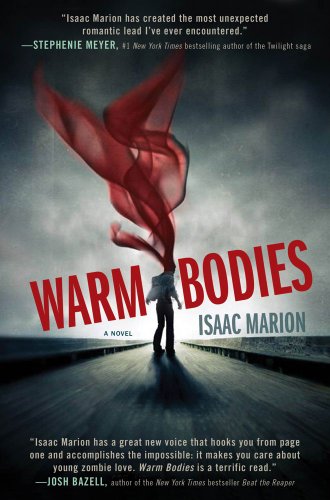
Warm Bodies: A Fresh Perspective From a Rotting Body


Introducing Warm Bodies, by Isaac Marion, a zombie love story that- wait, what? A zombie love story? Well, now I have heard everything. Vampires and werewolves seem likely enough candidates for paranormal romance, but zombies? They’re rotting! They can’t talk (well, in this book, they can form short, drawn out sentences)! They eat human flesh (which is somehow much worse than drinking blood to most people. I don’t know how that one slipped by)! And yet, despite all of this, Isaac Marion has created a zombie protagonist who is not only compelling, but a romantic interest. Most importantly, R is an anomaly in the zombie world. That’s how it always starts, isn't it?

For starters, R is quite a philosophical and contemplative zombie, which even he admits is strange and unnatural. Sure, he shuffles around an abandoned airport with a bunch of other zombies, but he wonders why zombies are the way they are. He muses a lot, wondering “How did this start? How did we become what we are? Was it some mysterious virus? Gamma rays? An ancient curse? Or something even more absurd?” Marion subtly gives back story to the apocalypse, either through R's thoughts or flashbacks from humans (I’ll get to that soon). R also contemplates about the purpose of being a zombie. He remarks that he could remember a time when he was purposeful and accomplished things, but now he just wanders an airport and eats flesh sometimes. He says “being dead is easy.” I myself have been wondering and even asking my friends if they’d rather live a simple life without responsibilities or worries, or if they’d rather live a full life currently, wrought with emotion, challenges, pleasures and hardships.

Everyone picks the latter choice.
R would as well.

Everything is flipped turned upside down (thanks, Will Smith) when R, his friend M and a small hoard of zombies attack a recon group of humans in the city. R kills a boy and takes a bite from his brain (those with weak stomachs, beware), instantly flooding him with the boy’s memories. The boy Perry’s memories are exactly the reason he likes brains; they’re his drug of choice and make him feel alive. When he sees the blonde girl form the boy’s memories, his girlfriend Julie, R is quite taken with her. He saves Julie, brings her back to the airport to protect her and to keep her safe. As R spends more time with Julie and revisiting Perry’s memories, R starts to feel alive and fall in love with this headstrong, beautiful girl. Of course, teenage romance just isn't easy, especially when the object of your affection’s dad wants you dead. This time for good.

I don’t want to give anything else away, but I would like to make the disclaimer that this book is pretty gritty at times. Don’t expect some light and fluffy paranormal romance novel. There is strong language at times. However, don’t let these deter you from reading this book. Despite the language and somewhat graphic descriptions, there is a lot more at heart to this novel than shock value. This is definitely not Twilight, and it doesn't ruin zombies either. It’s not just a simple love story. Marion describes zombies in a pretty gruesome and sometimes rather explicit way, especially when it comes to zombies’ actions in their attempt to feel human again. There actually is a battle where people get hurt, and gasp! Some even die! It's an actual book, instead a long fanfiction Stephanie sneezed out one day and handed to her publisher. Actually, Cracked.com did a funny piece on how to turn awful fanfiction into a bestseller. Twilight meets all 6 of the criteria. 


The best part about Warm Bodies is that it isn't a simple love story. R’s muses about how the zombie apocalypse started, what it is to be human, the interference of  the Boneys and who they are in our society (the people who want things to stay the same, no matter what) etc. These are all things I found myself relating to. I was able to stop and think about those questions and what they meant to me. Unfortunately for people I know, this also means I now ask them “what if” and “would you rather” questions, much to their chagrin.

The writing was concise, yet descriptive enough to get the picture. It was nice to have a break from the exhausting over-descriptive prose that appears in some novels I read. The characters are compelling and the story line is certainly unique. Besides, just check out what he wrote for his Amazon.com bio: I've written a few books, but most of them are terrible. Warm Bodies is the only one so far that's worth your time. I'm about to turn 30. I'm 6'3. White. Left handed. Mildly bearded. I write strange stories about strange events, often from the perspectives of strange things. I apologize in advance for any injury or inconvenience.” If that’s not enough of a clue to his writing style and sense of humor, then I don’t know what is.

Hey! He really is mildly bearded!

I would definitely recommend Warm Bodies to anyone who likes a little bit of romance, but also wants adventure, battles, zombie apocalypses, and likes the idea of being able to change.

I saw the movie a few weeks after reading the movie and I thought it was pretty good. The book didn't have too many complexities and it wasn't too long. These, along with a plot people can follow and like, are pluses in Hollywood studios’ books. It was Hollywoodified, what with casting a Caucasian actress for the part of a black girl, and changing the ambiguous age of R to definitely teenage. It added more humor, simplified the plot, and ditched the zombie wife and adopted zombie kids, but they rather cleverly kept the two kids in the movie as random characters who view scenes in a detached manner sometimes. I would say it’s a good companion to the book, more of a lighter, more humorous, more quirky teenage comedy romance adventure than anything else.


Oh good, well that narrows it down. Also, people keep comparing it to Twilight, but I didn't really see a connection, other than the fact that it has a boy with pale skin, a girl, romance and conflict. And the girl can look a little like Kristen Stewart at times, but she acts so much better. And her character isn't painfully awkward. On the one hand, you lose some of the complexity of the philosophical internal monologues, but on the other, Nicholas Hoult is a stunning actor and I can’t help but be drawn to an interesting movie plot with some inclusion of romance. And if it takes place during a zombie apocalypse, even better.

Friday, May 31, 2013

Animal Farm, or, Farmacology: Power is the Drug of Choice for Animals

Before I jump in with talking about Animal Farm, can we please acknowledge that title? I am legitimately proud of that title. Honestly. I literally fist pumped the air after coming up with it. I appreciate puns and witty wordplay, and I can only hope that other internet adventurers are similar. 

Obligatory explanation because my sister told me this joke might not make sense to people: Pharmacology literally translates to the study of drug in Greek, and now it is "the branch of medicine and biology concerned with the study of drug action" (courtesy of Wikipedia) I know it's a bit of a stretch, but I had to choose between clarity and the integrity of the pun. And I know it's pharmacology and not farmacology- the joke wouldn't have hit home as well if I had used correct spelling. I wanted to make a joke about pharmacology and how religion is the opiate of the masses, but there wasn't much mention of religion in this book so...

I know summer has just started for many people, which means it’s time to scour the newspapers for those lists of new books to pick up this summer. Or, in my case, it means to cross some old ones of my list first, especially when some of them are considered classics. In this case, it was Animal Farm by George Orwell. While many people read it for a high school English class, somehow I slipped through that one. I did, however, have to read A Tale of Two Cities. That was torture.

I am nothing if not a slave to culture, so I decided to cross the classic political satire off that long reading list of mine.

Animal Farm is a thinly veiled social commentary for abuse of power, especially in the cases of fascist and communist dictatorships. I don’t mean thinly veiled as an insult here; Orwell had a point to make and was not going to obscure his references, his characters or his message by writing subtly or complexly. That being said, the reader can easily decipher his meaning and decide if they agree with him.

As someone who disagrees with injustice or taking advantage of people, I was easily angered by the farm injustice and some of the animals. (Hey, I was Orwell’s target audience!) Even more frustrating was that this actually happened and even occurs to this day, but to different degrees and circumstances. It’s a quick read, and if you have an appreciation for classic literature, I would rent or buy this book ASAP. You may want to have the internet handy to look up references, which character means which and situations that the farm occurrences represent. For the sake of clarity, I will include some links to websites that do exactly that, because honestly, summer means no thinking or work. There’s something to be said as holding true to your mantra, isn't there?

1. Spark Notes, because it saves our ass in not only classes but in leisure reading, too, apparently.
2. Someone’s blog on class stratification.
3. A study guide pdf on the entire book- handy! 


Picture on right by chrisoatley on DeviantART, picture on right by John Lee on keebs.com. 

It was a refreshing change of pace to read a classic work of literature with a message and metaphors and symbolism, wasn't it? Well it's not going to happen again. I'll go back to reading my mindless, entertaining novels, thank you very much. 

Tuesday, May 14, 2013

Society Girls: More of that Brit Chick Lit

This week here at Brumbles Publications (if you can call a blog that even), we’re gonna switch it up! So far, I have reviewed dystopian fiction, young adult, an autobiography, science fiction, humor, and fantasy. Which, granted, isn’t too diverse, but hey, it’s better than reading the same genre every week. This week we’re reviewing chick lit!! Hooray! Something light and fluffy and not hard to concentrate on during finals week! And even better than that, it’s British chick lit.

Let me start off by saying one of the best, funniest, most entertaining and well-written chick lit books I’ve ever read is Playing James by Sarah Mason. (Holly Colshannon is a reporter for the Bristol Gazette and is assigned a piece that entails she follows Detective James Sabine around. Holly is clumsy, hilarious, outgoing and pretty impetuous. She is such a funny character, and naturally, chaotic and hilarious mishaps occur all around her, usually because of her doing.) I’m not reviewing that book because I read it a while ago and I just think you should read it, if you like a little Brit Chick Lit every once in a while.

The Colshannon adventures continue with Holly’s sister, Clemmie. Clemmie was an art appraiser until her boyfriend got her fired, so she took a year off to travel. Now she’s back in Cornwall to recover when Holly drags her into the missing case of Emma McKellan, who was a writer for the Bristol Gazette until she disappeared just days before her wedding. It’s like mystery lite, but with more eccentric characters and no murder. Of course, no book could top Playing James, so it’s tough to read a book by the same author and expect the same thing. But I’ll try.

Clemmie is a lot like her sister in the sense that she’s clumsy, headstrong, happy-go-lucky and funny, but she’s less successful career-wise and she has a very eclectic sense of style. To me, she was the slightly odder  but no less lovable one of the pair. Just because she wasn’t Holly didn’t mean she wasn’t endearing. Holly, on the other hand, was more subdued than in the first book. Perhaps it was because we were seeing Holly from another character’s point of view and we couldn’t hear the running monologue in her head or get her perspective on events. Or, maybe it was because Holly had to be toned down a little to make Clemmie shine. Either way, you get the effect that this isn’t another book about Holly, but Clemmie was the focal character. It is her book after all.

I loved the main plot of locating Emma because there was just as much hectic chaos and interesting turns of events. The rest of her large and eccentric family is more present in this book, and as I am from a large family, I can relate to that aspect. Except for the animals. We did not have a zoo in my house at any time. The romantic aspect of the book was predictable, but that is to be expected. I mean, come on, that’s the point of chick lit. People wouldn’t read it if it weren’t predictable. I mean, could you imagine a chick lit (not a drama book, there’s a difference) where one of them dies in the end or middle? 

Oh wait, that does exist! Introducing,Nicholas Sparks: killing off characters in Chick Lit since 1995. 
So if you’re looking for something to read on the beach, or in your room, or on a bus, or pretty much anywhere, but you just want to be along for the ride in a funny British rom com book, I would bring Playing James and Society Girls. I can guarantee you will laugh. Unless you have no sense of humor, in which case, get off my blog and go buy one. 

Monday, May 6, 2013

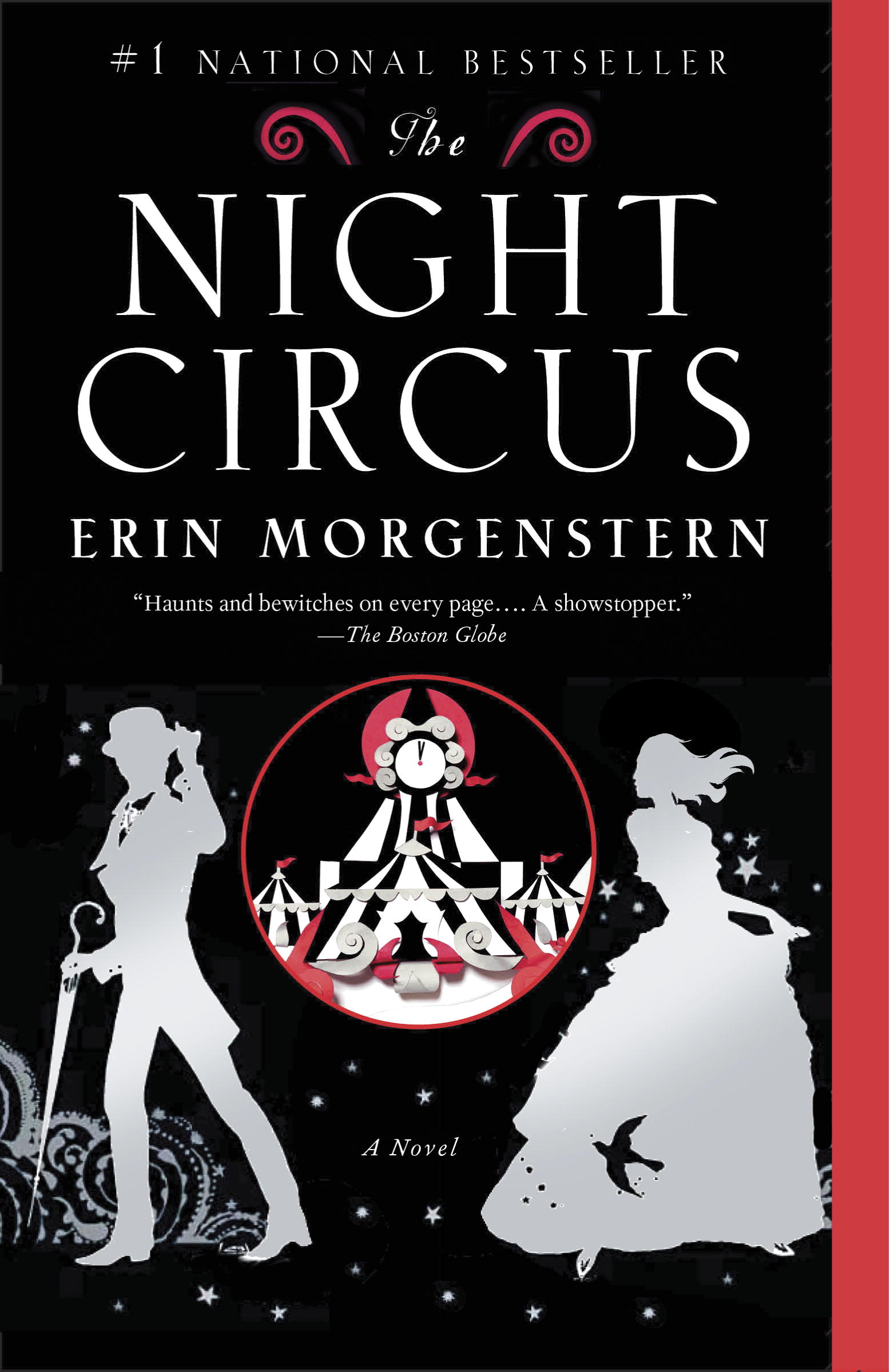
Night Circus: What's Black and White with Hints of Red?


“The circus arrives without warning.
No announcements precede it, no paper notices on downtown posts and billboards, no mentions or advertisements in local newspapers. It is simply there, when yesterday it was not.”

The whole idea of the Night Circus is simply charming. That is honestly the best word I can use. I’ll have you know, however, that charming just barely beat out about 10 other words: mysterious, intriguing, beautiful, elegant, ethereal, magical, provocative, dreamlike, captivating and exciting. These are only some of the words that could describe this book. There are hundreds more, but I highly doubt someone would want to read several paragraphs of synonyms. If you do, go outside, man. Stop going on thesaurus.com and go live your life. 
The idea for the Night Circus starts when wealthy and eccentric businessman Chandresh Lefèvre decides to hold these magnificent Midnight Dinners, to which he invites some people with unusual, if not extraordinary talents. Mme. Ana Padva is a former Romanian prima ballerina who now has a unique and gorgeous eye for fashion, Ethan Barris  is an amazing architect and engineer who can create almost anything, Tara and Lainie Burgess are jacks of all trades (dancers, librarians, consultants, actresses etc) who create a sense of atmosphere, Mr. A.H. is a mysterious man in a gray suit and Tsukiko is a contortionist of unparalled talent. Together, they create Le Cirque des Rêves

I had heard the book described as a mysterious circus and people wear red to distinguish the true enthusiasts  but the book is so much more than that. Marco and Celia are two children picked to be rivals by two opposing magicians, but “magicians” is an understatement. Prospero the Enchanter, also known as Hector Bowen, has a talent for magic that is beyond tricks and illusions. It’s….well, it’s more like magic, really.  His daughter is chosen to compete in a game of skills against Marco, a young boy selected by Bowen’s main opponent, Mr. Alexander H. (usually just A. H.). It is a test to see if more unconventional methods and the practical application of magic works better than a more studious and academic approach through books. However, as Celia and Marco compete through this circus, everyone’s lives in the circus becomes more and more tangled in the competition and the stakes constantly rise.

The great thing about this book is that the writing juxtaposes the theme and the purpose of this book perfectly. The writing is so graceful and descriptive, yet subtle at the same time. This is the Night Circus; it is not ostentatious or outlandish, but it is beautiful, rich and elegant. Everything Erin Morgenstern describes is just stunning: the food, the clothing, the locations, the circus, the tents and the acts within them. Describes isn't even the right word. She paints it for you. The foods at the Midnight Dinners sound so delectable. Every word she chooses is perfect and makes you hungry at the same time. I’m getting hungry just thinking about it! Oh wait, it’s 7:15 and I am currently making dinner. Whoops.


Seriously, I just ate and I'm hungry again. What the hell?
The circus she creates out of words seems so real, and again, the descriptors are chosen with great contemplation. It’s just a beautifully written book for a beautiful circus. But that doesn't do it justice, because the circus is so much more than that! It’s mystery, it’s something that some of us may dream of at night, it’s a place to escape to, somewhere beyond the natural confines. Such an imagination deserves applause in my book, but I am a bit biased as I like to think of myself as imaginative as well. Look, I’ll create something imaginative right now! Uh, this group of humanoid mythical beings go on a quest to defeat a dragon and claim the treasure! And there’s a wizard there, and trolls, and elves and…. Oh crap. That’s the hobbit. No wait! Okay, how about toys that wake up when their owners are gone and they have adventures and stories and maybe a fight and…. That’s Toy Story.

Moving on.

I could not put this book down, and I would heartily suggest you pick it up and give it a go. It is also nothing like Water For Elephants if that's what you're worried about. Except it has a love story and takes place in a circus... but that's beside the point. Who wouldn't want to read an enchanting tale about a magical circus, two young lovers, exotic locations, fascinating characters, an ongoing battle and impossible acts? I know I would. Wait, I just did. 

Friday, May 3, 2013

The Restaurant at the End of the Universe: Don't Panic. Continue Not Panicking.


“The Story so far:
In the beginning the Universe was created.
This has made a lot of people very angry and been widely regarded as a bad move.”

-The Restaurant at the End of the Universe, Douglas Adams

Could there be a more perfect beginning to this book? No, there is not. The opening to the book, perfectly combining humor, satire, history and science (I’m being facetious here) sets the bar pretty high for Douglas Adams’ sequel to the brilliant Hitchhiker’s Guide to the Galaxy. Luckily, he set the bar himself and knows how to vault over it like the literary genius/comedian that he is.

I do not think I can summarize the plot of this book, if the difficulty of wrapping the first book up into a neat little abstract has anything to say about it. The best I can do is give you a short play-by-play of the highlights of the book, so about every other paragraph (and that’s just an average). I think just the best of the best will suffice.

The introduction of Ursa Minor Beta, or “one of the most appalling places in the known Universe,” is just genius. It “is excruciatingly rich, horrifyingly sunny…[and] it can hardly be insignificant that when a recent edition of Playbeing magazine headlined an article with the words ‘When you are tired of Ursa Minor Beta you are tired of life,’ the suicide rates there quadrupled overnight.
Not that there are any nights on Ursa Minor Beta.”

The Restaurant at the End of the Universe (also known as Milliways), is a pretty hilarious concept, too, but only because your preconceived notions of the context of the word “end” here are shattered. When he writes “end” in the same phrase as “universe,” we all think of physical end, as in location, but Douglas Adams means “end” as in “destruction.” The restaurant is protected by a time bubble that resets itself every meal period so the diners can witness the end of the Universe. As it is a “time location” and not a “location location.” This way, you can come back multiple times.

As usual, Douglas Adams likes to shoot all your ideas about time travel and relativity to hell. Also, he introduces an amazing new tense that tells you how “to describe something that was about to happen to you in the past before you avoided it by time-jumping forward two days in order to avoid it.” Of course, that means that you must describe the event differently depending on if you’re talking about it in the future, the past, natural time, etc. It is known as the Future Semiconditionally Modified Subinverted Plagal Past SubjunctiveIntentional. This is to replace the “Future Perfect.” I cannot even describe this tense. It is practically a new language even J. R. R. Tolkien might be a little proud of.

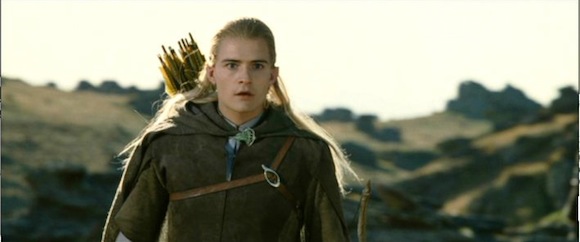
"Legolas! What wioll haven do your elf eyes willan seen?"
"They're willing taken the hobbits to Isengard!"
The existence of a spaceship so black you cannot make out its shape or even tell how close you are to it, let alone distinguish any of the controls in the ship. Because it’s black on the inside, too.

Then there's the almost-paradox of writing the guidebook: “The simplistic style in which [the statistics of The Hitchhiker’s Guide to the Galaxy] are written is partly explained by the fact that the editors, having to meet a publishing deadline, copied the information off the back of a packet of breakfast cereal, hastily embroidering it with a few footnotes in order to avoid prosecution under the incomprehensibly tortuous Galactic Copyright laws. It is interesting to note that a later and wilier editor sent the book backward in time through a temporal warp, and then successfully sued the breakfast cereal company for infringement of the same laws.” Amazing. Simply amazing.

I hesitate to disclose my favorite part of the novel, the end, but truthfully, I don’t think you can really have spoilers in a Douglas Adams book. Each sentence is not so much a an event not to be disclosed to non-readers, but more of another piece of an adventure. A stepping stone, if you will. If each Douglas Adams book were a ladder, each chapter is simply a piece of wood (or metal, depending on the type of ladder you’re imagining) that makes up the ladder. If you remove a splinter or even a rung, the entire ladder will not fall apart, but it does take away from the ladder’s essence.

So when I tell you my favorite part, it does not make the story unreadable. In a way, it’s like the universe itself; the story and the universe are infinite and could continue in any direction indefinitely.

The Restaurant at the End of the Universe
 ambled along, delighting me with every page, but the best (and funniest) part was the ending. Arthur and Ford end up on this spaceship, Ark B, to find millions of bodies in suspended comas. What kinds of people are they? “‘Hairdressers, tired TV producers, telephone sanitizers, insurance salesmen, personnel officers, security guards, public relations executives, management consultants, you name it.’” Why, you ask? And actually, Ford and Arthur essentially ask it themselves. “‘The idea was that into the first ship, the ‘A’ ship, would go all the brilliant leaders, the scientists, the great artists, you know, all the achievers; and then in the third, or ‘C’ ship, would go all the people who did the actual work, who made things and did things; and then into the ‘B’ ship–that’s us–would go everyone else, the middlemen.’” As funny as it is, it just keeps getting better. The planet they came from, Golgafrincham, sent Ark B off to “rid themselves of an entire useless third of their population. The other two-thirds stayed firmly at home and lived full, rich and happy lives until they were all suddenly wiped out by a virulent disease contracted from a dirty telephone.” Oh, the irony.

Of course, the downside to sending a colony of people such as these off to a new planet is that some things hold precedence over others. For instance, hairdressers electing to create curling tongs instead of developing fire. And in creating the wheel, the marketing department must first decide on a color. And instead of exploring the area, their film producers make a documentary on the indigenous cavemen in the area.
  

"I've always been told hairs before bears. As in protecting yourself from bears. You'd be surprised
 how much perfectly styled tresses can ward off danger."
But the most hilarious of all, and most satirical, is that they develop a fiscal policy. Ford wants to know how they can have money when they don’t make money. As a response to saying it doesn't grow on trees, the management consultant says “‘Since we decided a few weeks ago to adopt the leaf as legal tender, we have, of course, all become immensely rich… But we have also run into a small inflation problem on account of the high level of leaf availability, which means that, I gather, the current going rate  has something like three deciduous forests buying one ship’s peanut.’” So, to revalue the leaf, they are going to burn down all the forests. I cannot stress how loudly I laughed at this point.

I think Douglas Adams just sat in his room and decided to make fun of everyone he could think of. And as they say, the pen is mightier than the sword. The worst part is that I can actually see this playing out in similar situation, if to a lesser degree. I am just glad that Adams has commemorated it on paper. And, er, Ebook/tablet screen.

The book ends with Arthur trying to teach the cavemen to play Scrabble with rocks, “‘but they only word they know is grunt and they can’t spell it…. [He’s] probably spelled crzjgrdwldiwdc again, poor bastard. I keep on telling him there’s only one g in crzjgrdwldiwdc.’” Man, on a triple word score, that word would be pure gold.

Monday, April 29, 2013

A Natural History of Dragons: Quit Dragon Your Feet and Read This Book Already!

Look at the cover! It's so pretty!
If you’re anything like me, and I pray to God that you’re not, then you are horrified by the thought of just purchasing something without having “sampled” it yet. And in this case, I am of course referring to books and movies. Only on two occasions have I purchased a book because I thought it might be good and it turned out to be a BIG MISTAKE. And I mean “big” in the sense that I wasted several hours of my life attempting to read and like these books, but failing. And more than that, my competitive streak deflated at the thought that I was not returning to finish those books. Since then, I have not bought anything I haven’t read, seen, tried on, sampled, whatever.

It’s a good thing, then, that recommendations exist! I would feel much more at ease buying a book or movie from a source I valued, and such was the case of this book. Hank Green (for those of you not familiar with Nerdfighteria/Nerdfighters, Vlogbrothers, YouTube or John Green, the author of several best-selling Young Adult fiction novels, is an entertaining and pretty geeky vlogger whose videos I watch, and you should too) recommended several books in an early April VEDA video. Now, the other two were science fiction novels, and true sci-fi literature is something I have not delved into too deeply. But the third piqued my interest, partly because it had the word “dragons” on the title. Ever since How to Train Your Dragon, I have been started loving dragons. Hank Green's recommendation was interesting, as well. He described A Natural History of Dragons by Marie Brennan as “If J. K. Rowling, Charles Darwin and Jane Austen had a baby, that would be impossible. That would be a messed up baby. But if they wrote a book together, it would be this book.”

Is that not one of the strangest combinations of writers you've ever heard of? Okay, maybe not "ever". I could wrap my head around the Jane Austen and Charles Darwin part of it, and the Jane Austen and J. K. Rowling part, but could not fit all three of them together coherently. So I got it. And I read it. And I liked it.

One of the hardest questions I've ever had to answer. 

A Natural History of Dragons: A Memoir by Lady Trent by Marie Brennan is about a Victorian Woman named Isabella, and she is fascinated by dragons. Because dragons exist in her world, which is also Victorian England, but it’s called Spirling, but Brennan isn't fooling anyone, and she knows it. The just knows that Spirling is basically England, but with dragons. Isabella is fascinated by the anatomy and engineering of dragons. She wants to know how they work, how they behave, what they eat, what their lifestyles are like, where they live, everything. She is scientific, curious, headstrong and adventurous, a combination which often leads her into trouble and danger.

She and her husband join a small observation party, to study the rock wyrm(dragons) in Vystrana. This country is essentially Russia or some similar Eastern European country, but it’s hard to place it exactly. Lately, there have been dragon attacks, and this hardy group decides to find out the cause and stop the dragon attacks.

There is a good deal of intrigue and mystery as to why these dragon attacks are happening, and it’s not as simple as it would seem.  I love mystery, and often books with mystery have kept me up until early hours (6 a.m. one time) in a desperate attempt to finish the book. This book had enough intrigue to keep my attention, but not enough to stay up  too late (early?). I would gladly sacrifice several hours of sleep for the right book, but this was not such book.

The characters themselves are likable, and I liked that Isabella was adventurous. However, because this book is largely plot-based and mystery-driven, none of the characters have very strong personalities. They do not do outrageous things, have hilarious sayings, have a lot of character development or develop strong relationships. In fact, it was fitting to the writing style, given the fact that this book is set in Victorian times and Isabella is compared to Charles Darwin. In this sense, Brennan wrote it in a Victorian English style, but not so much that if Jane Austen were to rise from the dead and for some reason decide to pick up this book, she would not confuse it with one of her peers’ works. That might drive away some readers who lack the patience or tolerance for a less-than-dynamic writing style/voice.

The ending, too, wrapped a little too quickly and neatly for my taste. It was confusing, especially since the book is largely plot-based. I mean, I can understand wanting to finish a book that has already been going on for 300 pages, but this was a little too simple. It is just a book for entertainment, and Brennan knows that her readers are not expecting some profound declaration about the current state of society. In a way, the ending is satisfying.

There are some really gorgeous works of art by Todd Lockwood; he does fantastic fantasy art found here and here. If you like art, then I would suggest checking out his stuff.

Just of a few of the, well, few illustrations in the book. 

All in all, it was something you might like if you like scientific, adventurous and a little bit of dry humor, (“Between that and the abseiling, I think I left enough skin behind on those rocks to cover an entire person”), then you would not be remiss in reading this book. I mean, come on! It has dragons in it! If that’s not enough to convince you, then I don’t know what is.